
Why Vienna's housing age matters for a bathroom
The Town of Vienna's own history describes a quiet rural town of 1,237 people in 1940 that changed quickly once the postwar rush to the suburbs began, bringing nearly 10,000 new residents and a wave of new subdivisions in the 1950s. Census counts show the population growing from about 2,000 in 1950 to more than 11,000 in 1960 and over 17,000 by 1970. Plenty of the homes built in that period are still standing, many of them expanded or rebuilt over time, and the Town notes that new homes have kept blending with older ones.
For a bathroom, that means a wide spread of starting points. Some Vienna bathrooms are original, some have had one cosmetic refresh, and some were redone in a whole-house renovation. The older and less-touched the room, the more of the remodel happens in the parts you never see.
What older bathrooms tend to hide
Supply and drain lines
Plumbing materials have changed several times since the 1950s. An older bathroom may have original supply lines and drain pipe, or a patchwork of repairs from different decades. When the walls are open, it is the cheapest moment to replace what needs replacing, rather than tiling over pipe that may need attention later.
The floor structure
Decades of small leaks around a toilet or tub can soften a subfloor without obvious signs on the surface. Original tile may also be set on a thick mortar bed, which affects how a new floor, a heated floor or a curbless shower can be built. We cannot know until it is opened, which is why a good scope describes how floor repairs will be handled.
Ventilation
Many older bathrooms were built with a window and no fan, or with a fan added later that discharges into the attic. Virginia's residential code requires bathroom exhaust to discharge outdoors. A remodel is the right time to give the room a properly ducted fan.
Electrical capacity
A bathroom wired for one light and one outlet is now asked to power vanity lighting, a fan, hair dryers and possibly a heated floor or lit mirror. New circuits and GFCI protection are common parts of an older-home bathroom scope.
Walls that are not quite square
Older framing settles. That shows up when a new vanity, glass enclosure or large-format tile meets a wall that is out of plumb. Experienced installers plan for it, but it is one reason measurements for glass and countertops are taken after the walls are rebuilt.
Before you start: what to look at yourself
- Stains or soft spots on the ceiling below the bathroom
- A floor that flexes near the toilet or tub
- Grout that keeps cracking in the same place
- Low water pressure or slow drains at more than one fixture
- Peeling paint or mildew on the ceiling, a sign the fan is not doing its job
- Whether the fan duct ends at an exterior cap or in the attic
None of these means the project is in trouble. They help us scope it realistically.
Decide what to keep and what to change
Older homes sometimes have features worth keeping, such as a window that gives the room natural light, or a generous linen closet. Others are worth changing, like a tub nobody uses or a vanity squeezed beside the door. Start with how the room is used, then decide whether the layout stays or changes. Keeping fixtures near the existing drains keeps cost down; moving them opens up better layouts.
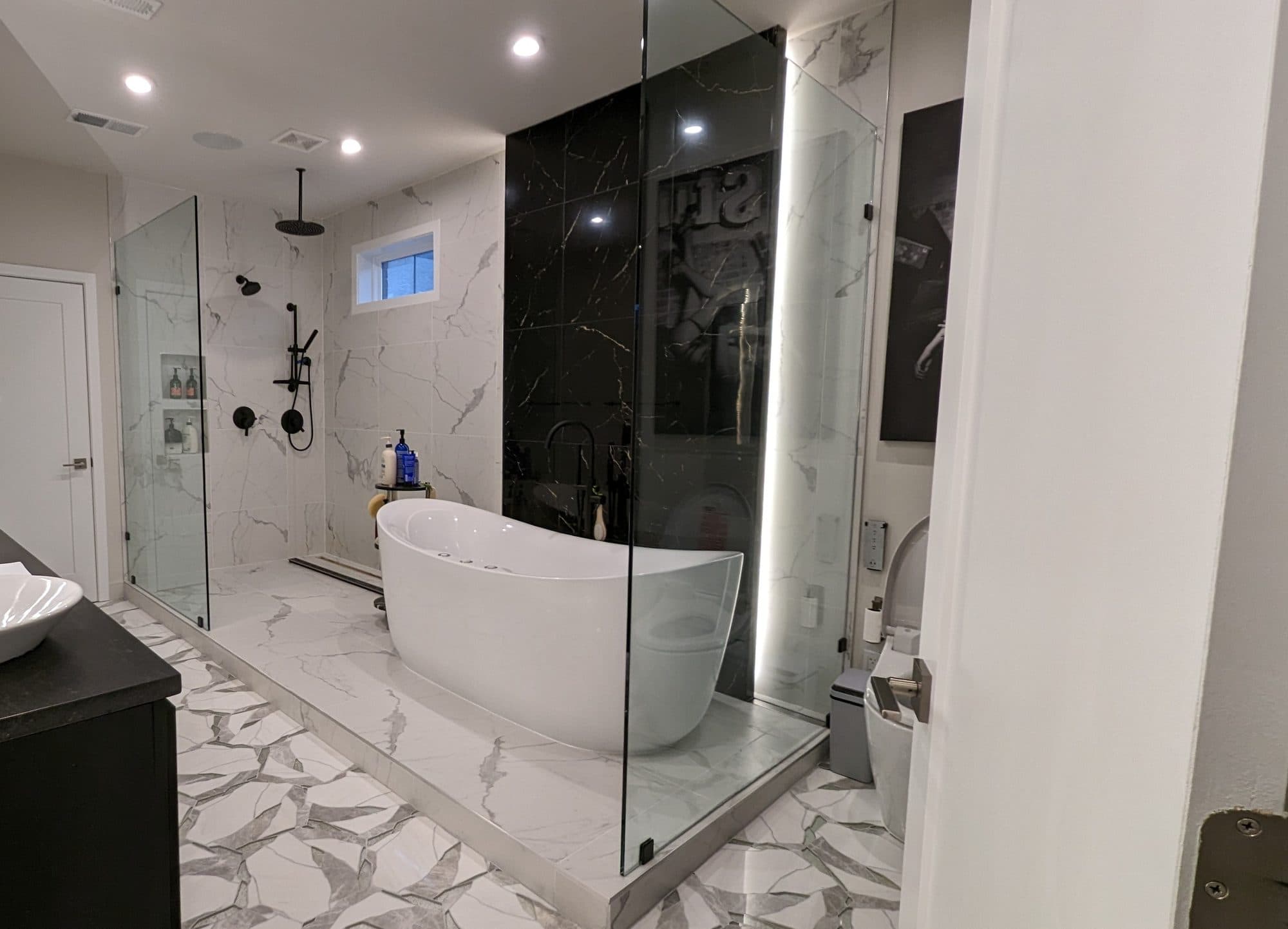
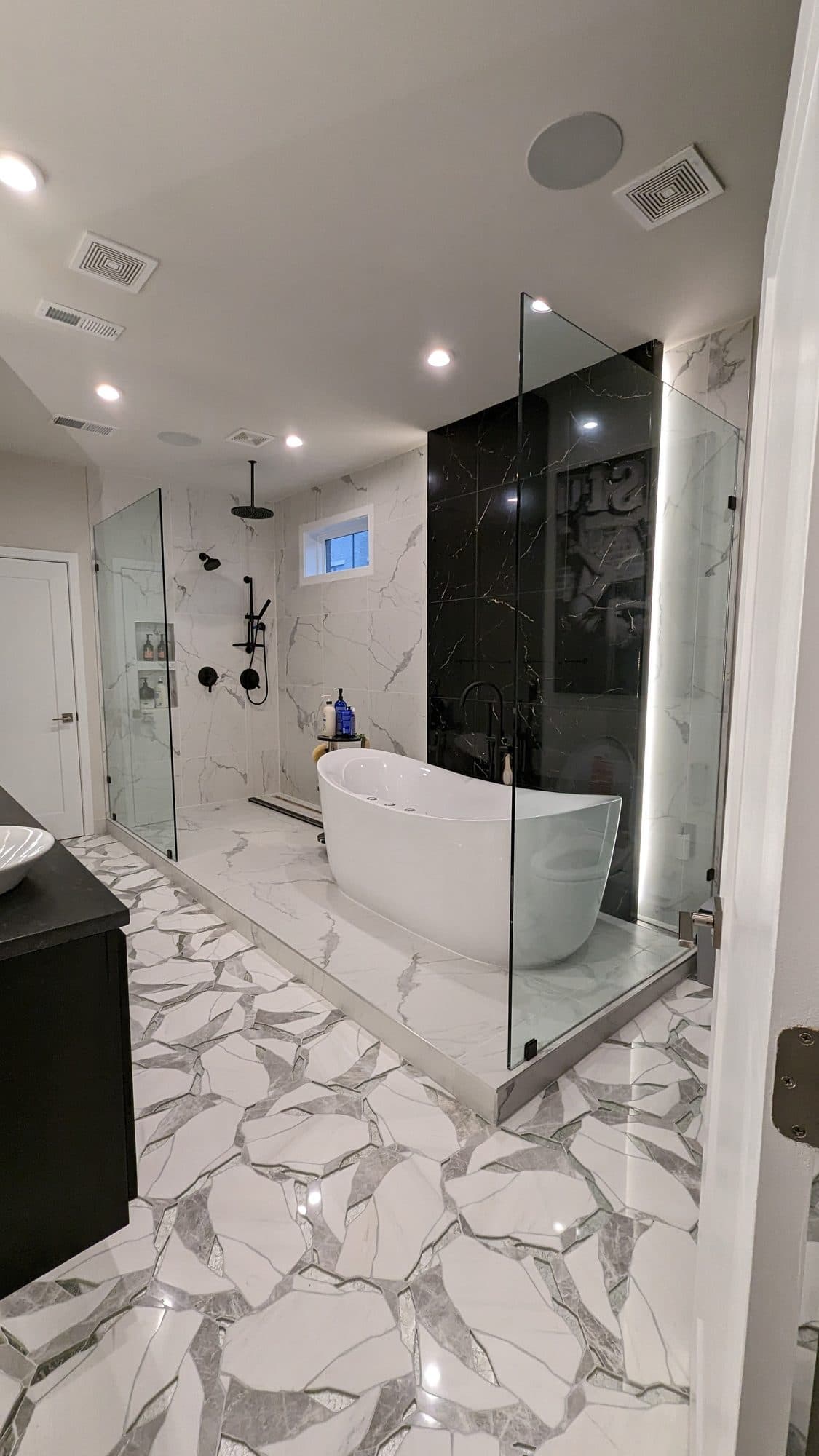
Our Vienna project shows where a full rethink can go: a primary bathroom built around a freestanding soaking tub, a black marble accent wall and a glass walk-in shower with a rainfall head. Not every older bathroom needs that, but it shows that an older house is not a limit on the finished room.
How to scope the unknowns
The honest answer to what is behind your walls is that nobody knows until they are open. What you can control is how the contract handles it. Look for a scope that:
- Names the work it does include behind the walls, such as supply lines, drain connections and the fan duct
- Explains how hidden damage is documented and priced before extra work starts
- States which permits the work needs and who handles inspections
- Separates allowances from fixed prices
Permits for an older-home remodel
Replacing plumbing and wiring is exactly the work Fairfax County's permit list covers: new, repaired or relocated plumbing, electrical and mechanical fixtures. That is true inside the Town of Vienna and in the unincorporated parts of the Vienna area. Inspections while the walls are open are also a useful check on old work you are keeping.
How old are most homes in Vienna, VA?▸
Vienna grew fast after World War II; the Town's history describes nearly 10,000 newcomers and new subdivisions through the 1950s. The housing today mixes homes from that era with newer construction, so ages vary widely by street.
Should I replace old plumbing during a bathroom remodel?▸
If the walls and floor are open, it is usually the most economical time to replace aging supply and drain lines serving the bathroom. We assess what is there during demolition and the scope explains how it is handled.
Can an older bathroom get a curbless shower?▸
Sometimes. It depends on the floor framing and how the existing floor was built. We check before recommending it.
Will my remodel cost more because the house is old?▸
It can, mainly because of concealed conditions. A good written scope makes the process for handling them clear before work starts.